The five-second operator: what a security photo can prove
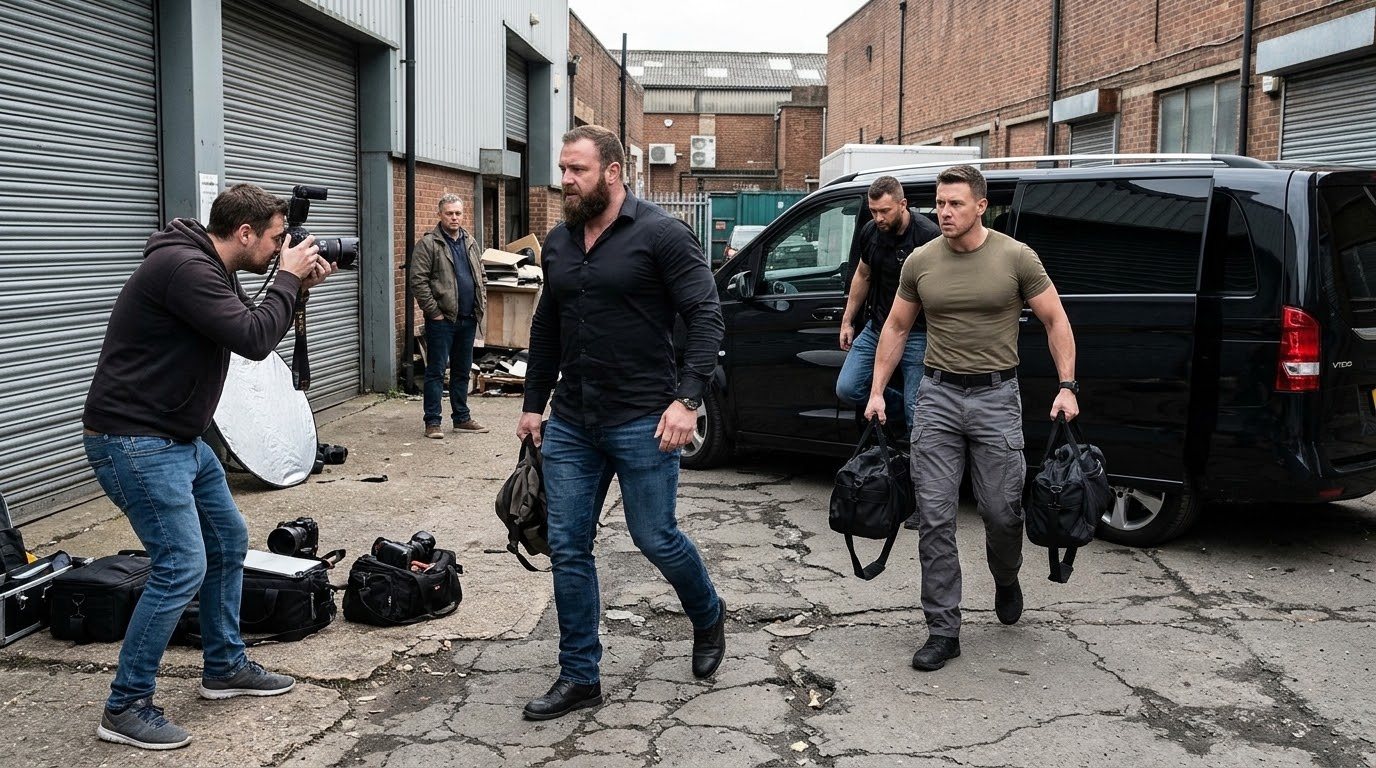
This is not a photograph. I generated it with an AI image tool in about five seconds, to make the point below.
Look at the image above. A close protection team steps away from a van while a photographer frames the shot. The men, the van and the photographer do not exist.
Now look at the hands. The man walking past the open van door has a heavy bag in each hand. Getting a principal into or out of a vehicle is one of the moments protection teams rehearse most, and a team member with both hands full is in no position to open a door, guide the principal or respond to anything. The AI learned what "protection team" looks like from photographs like this, and it reproduced their flaw along with their look.
Security providers have always sold themselves with pictures: teams beside vehicles, blurred faces, kit bags. A headline number often sits alongside, such as how many teams the author has audited and how many failed. Until recently, a picture like that at least showed that people, a vehicle and a location had been brought together. It no longer shows even that.
This issue is not about any one firm, and I am not going to judge anyone's competence from a picture. Nobody can. The useful question is the buyer's: if an image now costs nothing, what should you ask for instead?
Claim 1: "The photos show what we do"
A marketing photograph was never an operational record. It has no date you can rely on, no named client and nobody accountable for it. Generated imagery removes the little weight it had. A blurred face does not change this either way: it hides nothing from people who know the person, and it proves nothing to people who don't.
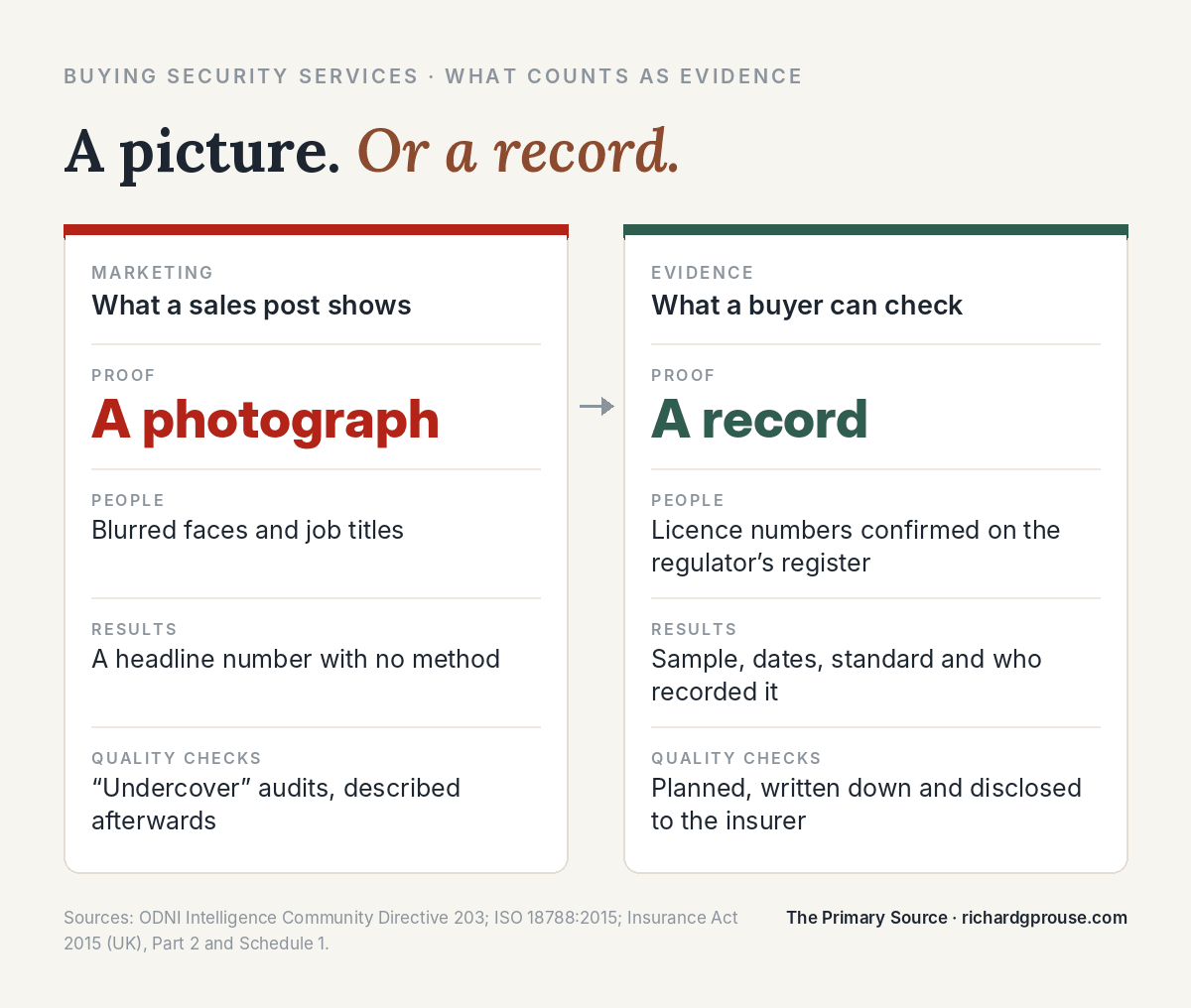
So treat an image as decoration and ask for things you can check. A reverse image search takes seconds. In the United States, security licensing is set state by state, and many states let you check a licence online: California's Bureau of Security and Investigative Services and the Texas Department of Public Safety (through its TOPS portal) both do. In the UK, a close protection licence can be confirmed on the Security Industry Authority's public register in about a minute.
Claim 2: "We audited the teams, and most failed"
A statistic is evidence only if you can see how it was produced. The US intelligence community's analytic standards (ICD 203) ask an analyst to describe the quality of their sources, to separate what is known from what is assumed, and to state their uncertainty. Apply the same test to any audit figure in a sales post: how many teams, over what period, measured against what standard, and recorded by whom?
If none of that is given, the figure may be true. You simply cannot tell, and neither could a court.
Notice too where these stories put the blame. If a team leader was hired on a CV that nobody checked, the failure belongs to whoever did the hiring and signed the contract, not only to the team leader. For a buyer, that is the uncomfortable part: the vetting question comes back to you.
Claim 3: "We test teams undercover"
Some providers describe placing an auditor inside a working protection team without the team leader knowing. Before agreeing to anything like that, ask three questions.
Who is in charge if something happens? A protection team works because everyone in it answers to one leader. A person inside the principal's close team who is secretly working to a second brief splits that authority at the worst possible moment. If you want to test a team, there are ways to do it from the outside: a surveillance detection exercise, or an announced audit authorised in writing, that leave the chain of command intact.
What does your insurer know? Under the UK Insurance Act 2015, a business buying insurance must make a fair presentation of the risk before the contract is entered into, and again when it is changed. That means disclosing every material circumstance it knows or ought to know: anything that would influence a prudent insurer's judgement. If the duty is breached, the insurer's remedy depends on what it would have done had it known. It may avoid the policy, apply the terms it would have imposed, or reduce a claim in proportion. Where the breach was deliberate or reckless, it may avoid the policy and keep the premium.
In the United States there is no single equivalent: what must be disclosed, and what an insurer can do about a misrepresentation, depends on state law and on the policy wording. The practical step is the same everywhere. Whether a particular audit method is a material circumstance for a particular policy is a question for your broker and insurer. I am not a lawyer and this is not legal advice. But the answer should be in writing before the audit starts, not argued about after a claim.
What record will it leave? An audit exists to produce evidence someone else can rely on. ISO 18788, the management-system standard for private security operations, expects performance to be evaluated in a planned and documented way. If an auditor sees serious misconduct, the person should come off the team. How that is recorded decides whether the decision holds. In the UK, a dismissal is judged on whether the employer investigated reasonably and followed a fair procedure, which is far easier to show with a written account made at the time than after a confrontation in a corridor.
Why the paperwork matters
When security fails and someone is hurt, the claim is usually brought against the organisation that owned the site or hired the provider. The US Chamber of Commerce's Institute for Legal Reform, a business group that campaigns for limits on lawsuits, counted 1,288 US jury verdicts of $10 million or more in personal injury and wrongful death cases between 2013 and 2022. Premises liability made up 14.3% of them, with a median award of $20 million. Negligent security claims sit in a separate category, "other negligence", at 10.4%. One example in the report is a $43 million verdict against a pharmacy chain in Georgia, later upheld on appeal.
Those are US figures from a body with a stake in the argument, and they say nothing about how often such cases arise. What they do show is the scale at stake when a court asks what care was taken, and how little a brochure helps in answering.
That question is the subject of my working paper on documentation and residual liability. It models the risk left over after a control as the exposure multiplied by one minus the product of two things: how well the control works, and how well it is documented. Because the two are multiplied, a strong control with no record behind it counts for very little. The paper is a model, not a measurement, and it has not been peer reviewed. The point it formalises is simple: a control you cannot evidence gives you little protection once you are asked to prove it.
Before your next renewal: the five-record check
Before you hire or renew a security provider, ask for five things. Each is a record, not a picture.
- Licences you can verify yourself. Licence numbers for every person deployed, checked against the regulator's register, not a photocopy.
- Insurance, confirmed by the insurer. A current certificate, and written confirmation from the broker or insurer that the way the provider works, including how it tests its own teams, has been disclosed.
- The method behind any number. For every statistic in the proposal: the sample, the dates, the standard used and who recorded it.
- A real record, redacted. One recent, anonymised example of a shift log, an incident report and an audit report, so you can see what you would receive.
- The misconduct process. Who is told, what is written down and who decides when a team member behaves badly.
A provider that can hand these over within a week is showing you something no photograph can.
If you would like a second pair of eyes on those records, or on your own procedures, Confidential Risk Consulting reviews them as a fixed-price, independent documentation audit, done remotely. Or book a free 30-minute call to talk it through.
Download this issue as a printable briefing (PDF) to share with your procurement or risk team.
Sources
- Insurance Act 2015 (UK), section 2: application of the duty of fair presentation, including variations
- Insurance Act 2015 (UK), section 3: the duty of fair presentation
- Insurance Act 2015 (UK), Schedule 1: insurers' remedies for qualifying breaches
- U.S. Chamber of Commerce Institute for Legal Reform: Nuclear Verdicts, an update on trends, causes and solutions (May 2024), pp. 8 to 11 and 24 to 25
- Office of the Director of National Intelligence: Intelligence Community Directive 203, Analytic Standards
- ISO 18788:2015, Management system for private security operations
- Acas Code of Practice on disciplinary and grievance procedures (UK)
- California Bureau of Security and Investigative Services: verify a licence
- Texas Department of Public Safety: Texas Online Private Security (TOPS)
- Security Industry Authority (UK): register of licence holders
- Prouse, R. G. (2026). Bridging the Documentation Void (SSRN working paper)
Get the next issue
One security or risk claim going around, checked against the original evidence, plus a practical tool you can use. Every two weeks.
Need checks like this built into your own work? I build fixed-price checkers, trackers and reports that trace every claim to its source. Book a free 30-minute call.